

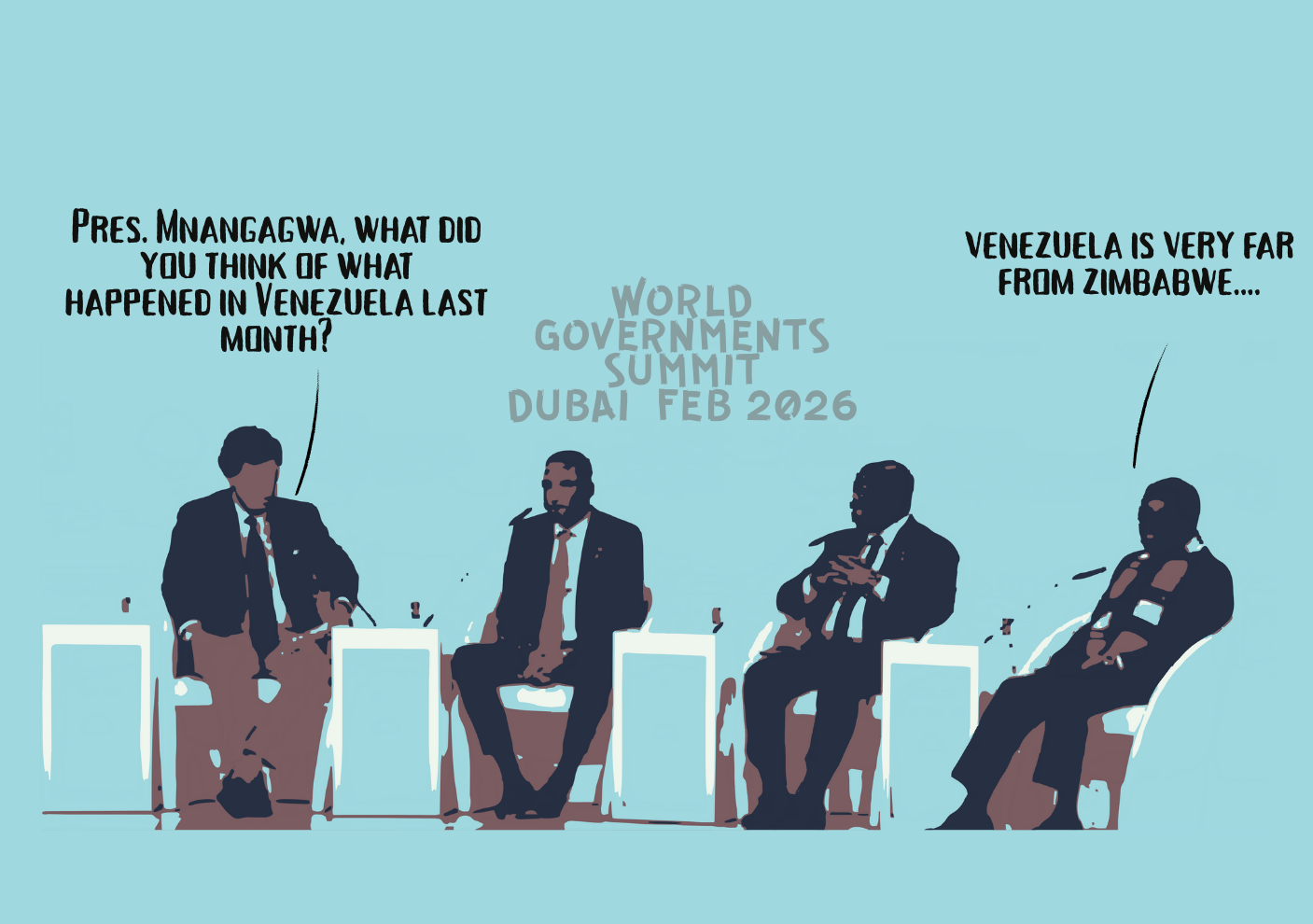
What played out in this video of a panel discussion at the World Governments Summit stage in Dubai was that the Zimbabwean president failed to prove he knows anything about the well-publicised US onslaught on Venezuela.
Asked a basic, open-ended question“President Mnangagwa, what did you think of what happened in Venezuela last month?” Zimbabwe’s Head of State offered an answer that revealed a startling disengagement from the world he claims to lead within.
“Venezuela is very far away from Zimbabwe.”
Geography, apparently, was his defence. As if distance cancels relevance in a globalised political and economic system where decisions in Caracas ripple through oil markets, sanctions regimes, diplomatic alignments and multilateral institutions that Zimbabwe itself depends on.
What followed was worse.
A veteran head of state, in office for decades in one form or another, admitted, on an international platform, that he does not really know what happens in Venezuela, casting doubt on what is even “read” in Zimbabwe.It was an admission of detachment.
For a president, ignorance of international developments is not a minor flaw. It is disqualifying.
World leaders are not elected to manage borders alone; they are entrusted to navigate a complex web of global power, economics, conflict, alliances and precedent. What happens to other heads of state matters precisely because it signals what is possible, what is punished, what is tolerated — and by whom.
Former leaders such as President Mugabe commanded international platforms through wide reading and intellectual preparation. In contrast, the current president is apparently better known for imbibing hard liquor, coitus-seeking behaviour and other forms of excessively unserious conduct.
A president who cannot articulate even a basic view on such an internationally huge case is either dangerously uninformed or no longer mentally agile enough to process the world as it is. Neither option inspires confidence.
Cognitive decline does not announce itself loudly. It shows up in hesitation, deflection, and an inability to engage with abstract or external realities. W
hen a leader retreats to “it is far away” as a response to a substantive geopolitical question, it raises legitimate concerns about capacity, not just preparation.
Presidents must know what is happening beyond their borders because:
- International crises shape global markets that affect fuel, food, and currency stability.
- Precedents set elsewhere inform how power is challenged or protected at home.
- Diplomacy is impossible without awareness.
- Silence or ignorance is itself a position — and often an expensive one.
On a stage meant to showcase global leadership, Zimbabwe was represented by a man who appeared uninterested, uncurious, and unmoored from the world beyond his immediate political bubble.
That moment in Dubai was the latest embarrassment.
We share the script below:
Host: President Mnangagwa, what did you think of what happened in Venezuela last month?
Pres Mnangagwa. Venezuela is very far away from Zimbabwe.
Host. Yes it is. Yes, yes sir, but I wonder, I still wonder as a head of state, a long time head of state, what you thought of that.You must pay attention to what happens to other heads of state.
Pres Mnangagwa: Yes, but I don’t know what we really read in Zimbabwe actually happens in Venezuela, but from what we read, we are interested to know why it is happening.


Leave a Reply